Dear Deb #4: On offshore teams, accountability, and a failure of nerve.
Dear Deb,
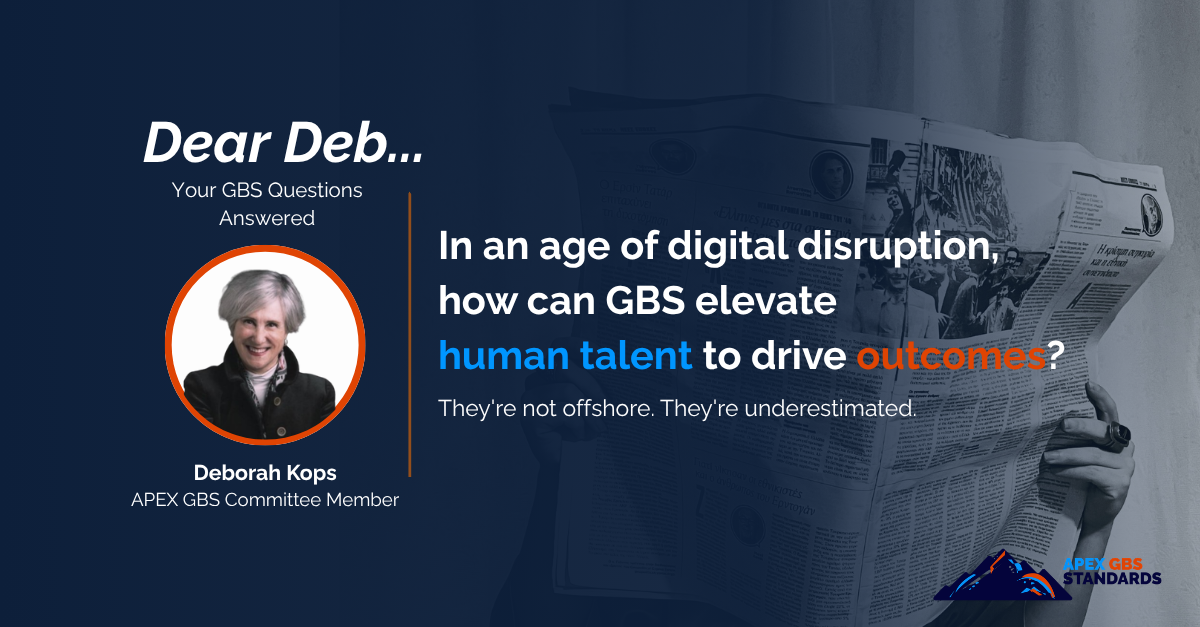
In an era dominated by talk of digital disruption, how can GBS organizations elevate the role of human talent, particularly highly trained offshore teams, to drive measurable business outcomes?
Janelle Aslam, VP Product & Innovation, SEBPO
Dear Janelle,
I’m going to turn your question inside out.
Let me start with the part no one says out loud. But I will.
If you are still describing your teams as “offshore,” you’ve already decided the role they’re allowed to play. It isn’t a leading one.
I don’t mean this as a linguistic quibble. I mean it quite literally. The minute a team is framed as offshore, they are positioned as somewhere work goes after it has been defined. A destination, not a source of direction.
And that, more than any lack of digital capability, is why so much highly trained talent sits frustratingly adjacent to value rather than driving it.
I see it all the time. Teams that are sharper than the stakeholders they support, closer to the data than the people making the calls, and far more aware of where the process is quietly failing. And yet when the conversation turns from “what is happening” to “what should we do,” they step back. Or are asked to.
Not because they aren’t capable. Because the model, and the language that underpins it, has already cast them in a supporting role.
So when you ask how to elevate human talent, particularly in these so-called offshore locations, the answer isn’t “give them more training” or “expose them to more digital tools.” Those things help at the margin. But they don’t change the game.
You change the game by changing what they are accountable for.
Right now, most of these “offshore” teams are measured on how well they execute. Volume. Timeliness. Accuracy. All perfectly reasonable metrics—if your ambition is to run a factory.
But if you want business outcomes, you have to hand over something that resembles an outcome.
Not “process invoices within SLA,” but “improve working capital.”
Not “close the books on time,” but “surface and resolve financial risk before it lands.”
Not “deliver HR transactions,” but “improve workforce stability and hiring effectiveness.”
The shift sounds obvious when you say it like that. In practice, it’s uncomfortable because it forces two things to happen that most organizations politely avoid.
First, you have to give these teams real decision rights. Not advisory input that can be ignored, but the ability to change how work is done, escalate when it isn’t, and, occasionally, say no. You cannot ask someone to own an outcome while ring-fencing all the levers that drive it.
Second, you have to stop treating location as a proxy for importance. The work that matters most should sit with the people best placed to improve it, not the people closest to headquarters. In a world where platforms are shared and data is accessible, the idea that proximity equals control is usually more habit than logic.
None of this works, however, if the teams themselves continue to lean into the very label that sidelines them.
I have lost count of how many times I’ve heard highly capable leaders introduce themselves as “head of offshore delivery” or “part of the offshore team,” as if they are politely disclaiming their own irrelevance. You don’t get invited into the decision if you’ve already announced that your role is to execute it.
The teams that break out of this pattern do something subtly but powerfully different. They stop talking about where they sit and start talking about what they own. They frame themselves around a process, a product, or a business outcome. They ask better questions, not just “how do we do this faster?” but “why are we doing this at all?” and “what would happen if we did it differently?”
And, crucially, they persist long enough for the organization to adjust to them.
Because there is a final truth here that is worth acknowledging. Enterprises are quite happy with the current arrangement. They get capable execution at scale, without having to share control. Really elevating talent means redistributing authority, and that is never a frictionless exercise.
Which is why this isn’t just a talent agenda. It’s an operating model choice.
If you want measurable business outcomes, then design the model so that the people closest to the work are also accountable for improving it. Fund that accountability. Govern it. Defend it when it gets uncomfortable.
And for heaven’s sake, stop calling them offshore.
Because as long as you do, you will continue to get exactly what you have designed for: teams that are very good at doing the work and structurally prevented from shaping it.
And in a world that keeps insisting the future belongs to those who can rethink how work gets done, that’s not a talent problem.
It’s a failure of nerve.
Deborah